/BB%20logo2.png?width=2047&height=784&name=BB%20logo2.png)
HubSpot for Franchises
One Customer Platform for Your Entire Franchise Network
Franchise organizations rarely have a technology problem because they lack software. They have a technology problem because they have too much of it.
Corporate marketing runs one set of systems. Franchise development operates another. Individual locations use their own CRMs, inboxes, spreadsheets, and sales processes. Customer and revenue data lives in POS, ERP, field service, scheduling, and other operational platforms. Leads move between corporate and franchisees with limited visibility into what happens next.
The result is a fragmented technology stack that makes it difficult to answer basic questions:
- Where are our best leads coming from?
- Are leads getting to the right franchisee quickly?
- What happens after corporate sends a lead to a location?
- Which locations are actually following up?
- Which marketing programs are generating customers and revenue?
- How is our franchise development pipeline performing?
- Can corporate see performance without taking control away from franchisees?
- Do our systems share enough data to create a complete picture of the customer?
HubSpot can become the connective layer across that ecosystem.
Bayard Bradford helps franchise organizations design, implement, integrate, and scale HubSpot across complex multi-location environments—giving corporate teams greater visibility and governance while giving franchisees tools they can actually use.
Franchise Organizations' Existing Pain with CRM
Most CRM platforms were designed around a relatively simple relationship: one company selling to its customers.
Franchises don't work that way.
A franchisor may need to manage hundreds of independently operated locations while simultaneously supporting consumer marketing, local sales, franchise development, franchisee onboarding, customer service, corporate reporting, and dozens of connected technology platforms.
That creates a fundamentally different CRM architecture problem.
A successful franchise CRM needs to balance two competing requirements:
Corporate needs consistency, governance, visibility, and data.
Franchisees need simplicity, autonomy, local relevance, and clear value.
Go too far toward centralization and locations resist adoption. Go too far toward decentralization and corporate loses visibility.
We design HubSpot environments around that balance.
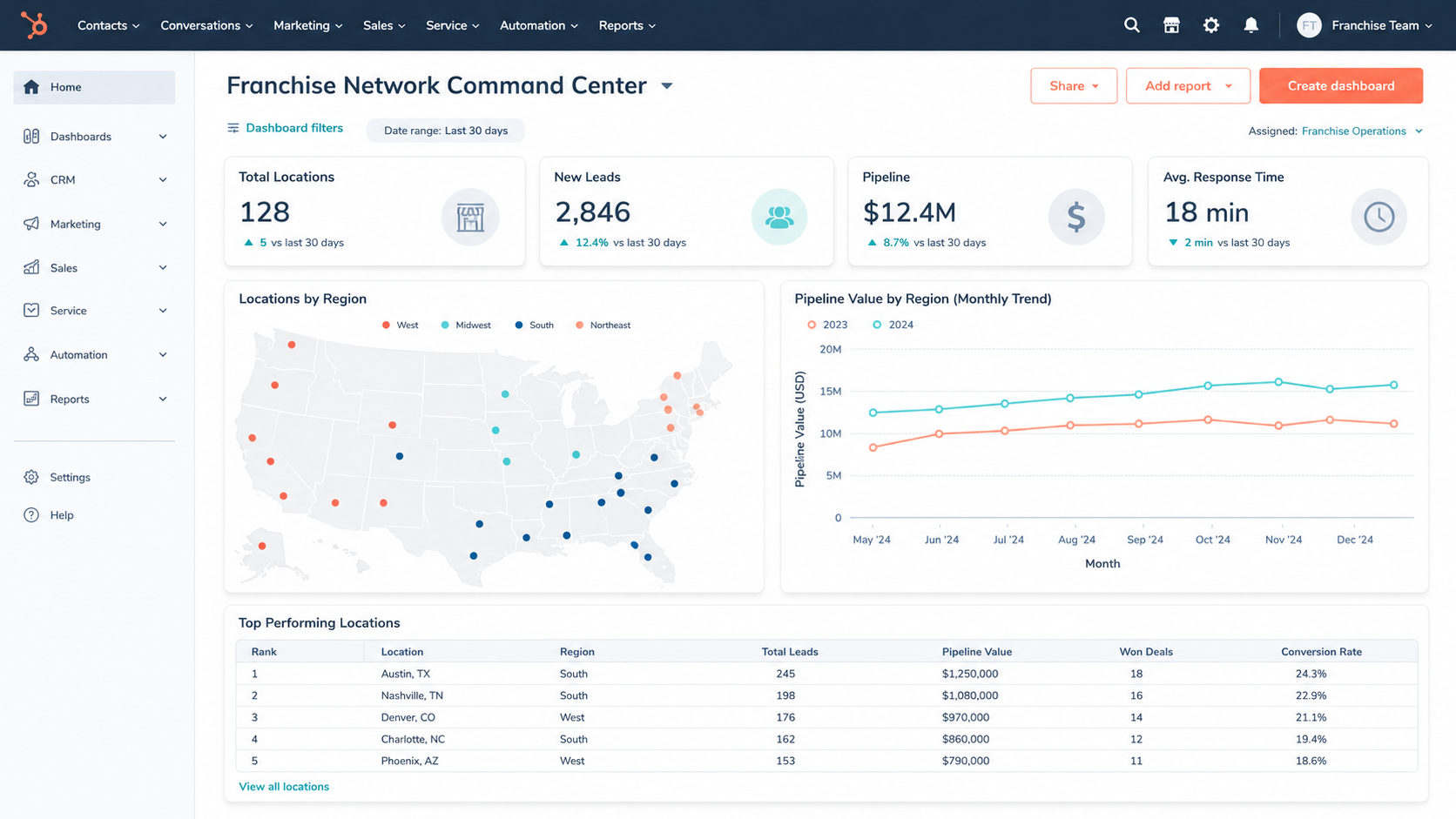
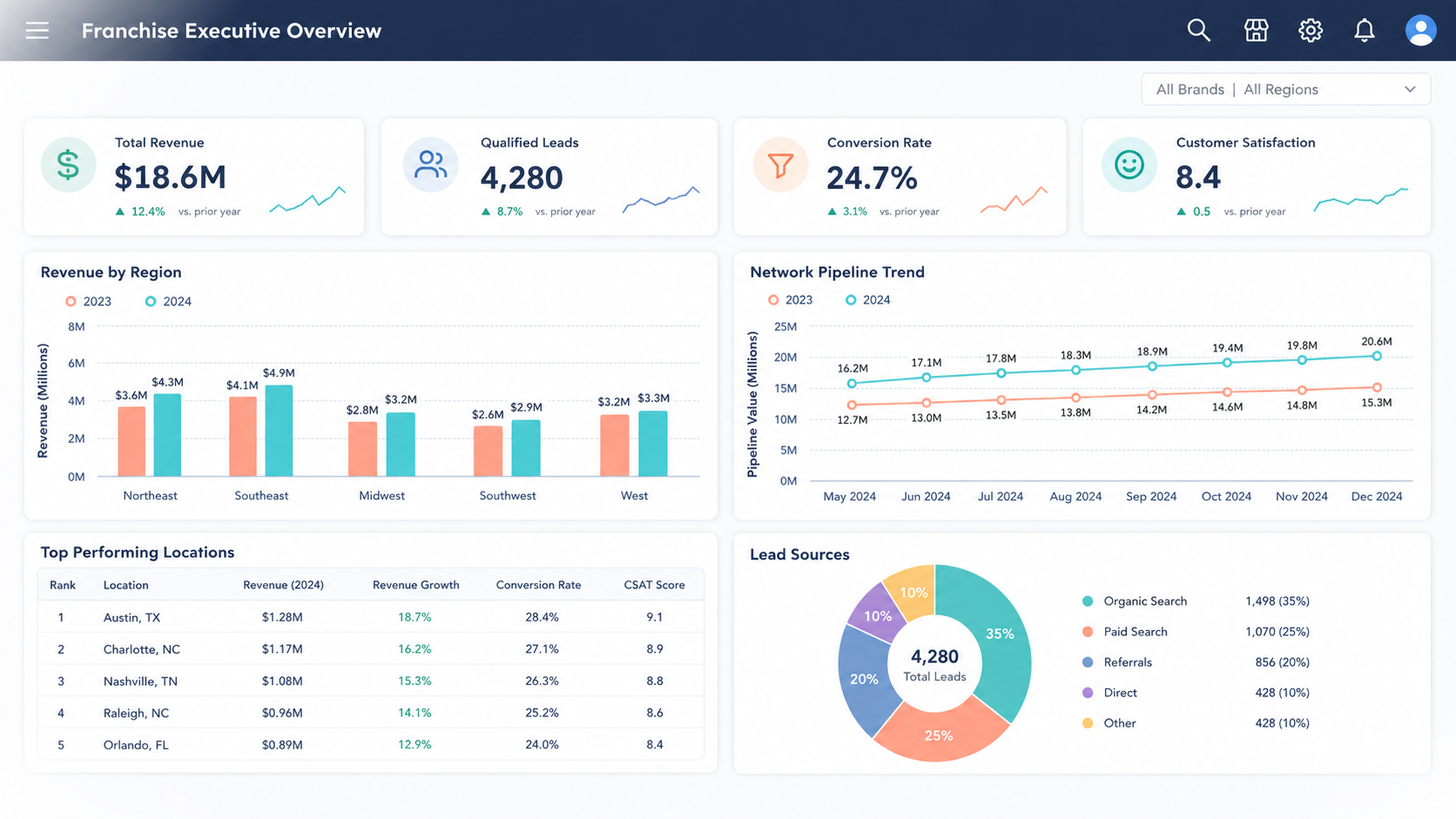
See What's Actually Happening Across Your Franchise Network
Franchise executives shouldn't need twenty spreadsheets to understand what is happening across the network.
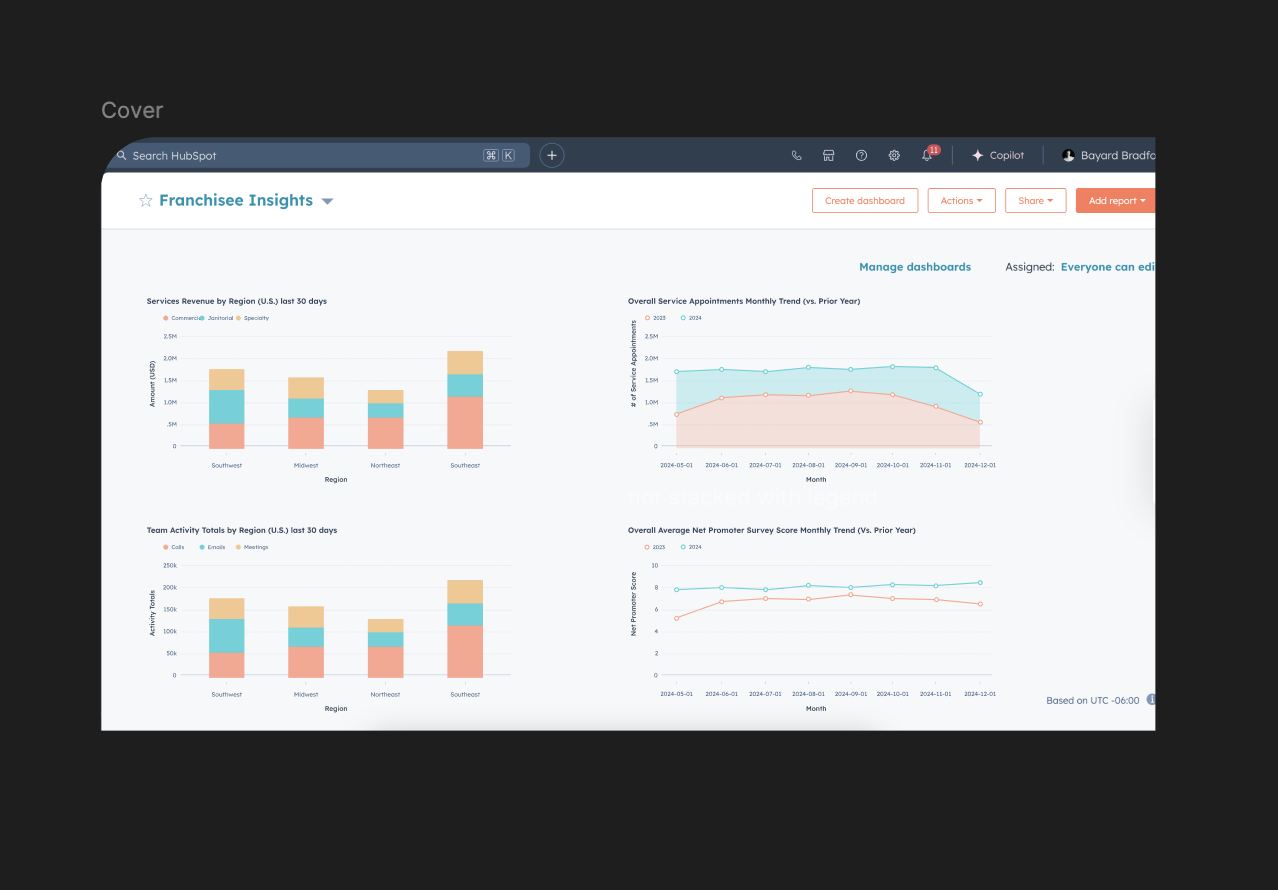
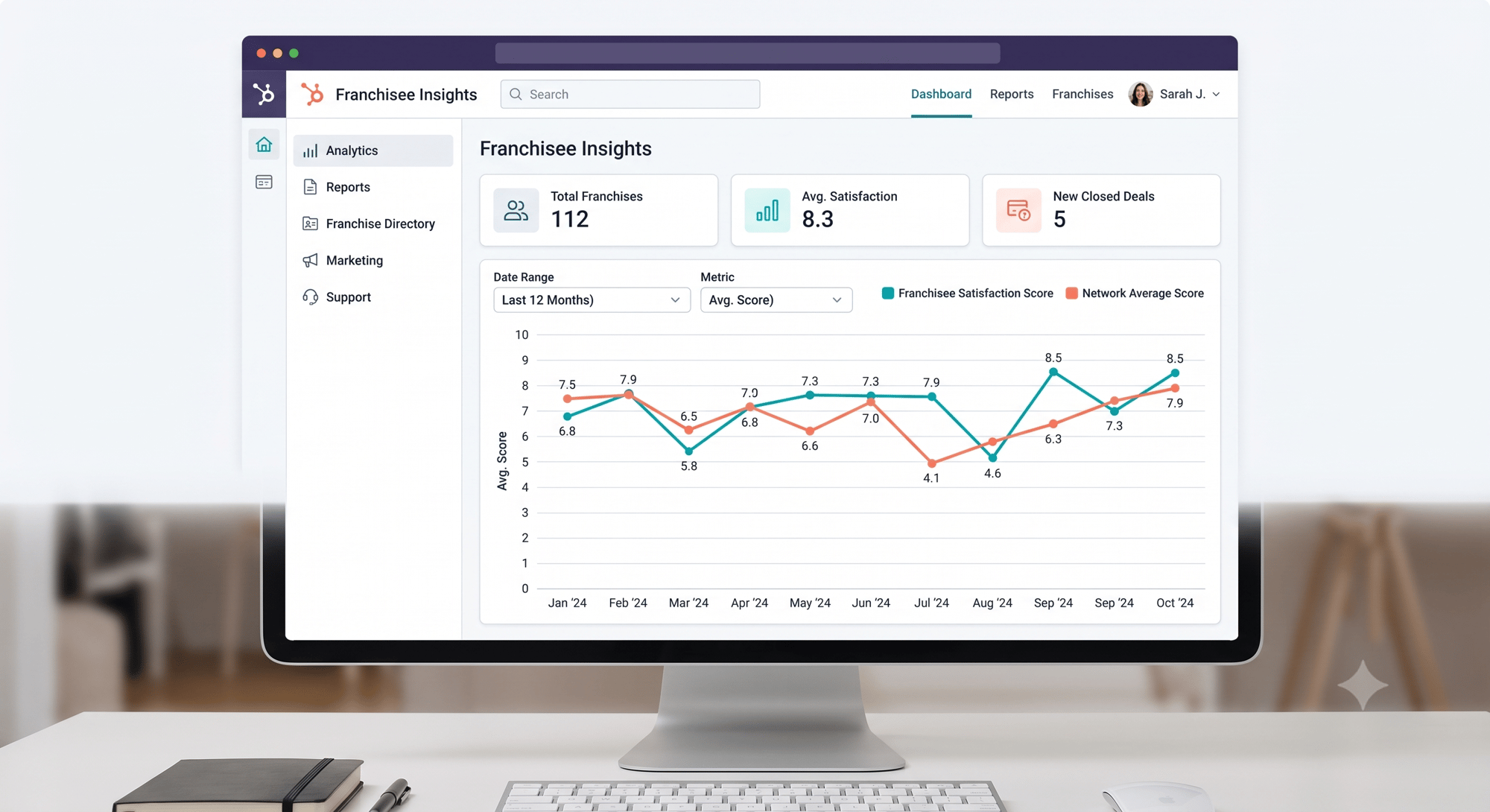
A properly designed HubSpot environment can create reporting at multiple levels of the organization.
Corporate executives can see network-wide performance.
Regional leaders can compare markets.
Franchisees can see their own pipeline and performance.
Marketing can understand lead generation and attribution.
Franchise development can understand candidate acquisition and pipeline velocity.
Operations can identify locations that need additional support.
Depending on your data architecture, reporting can include:
- Leads generated by location
- Lead response rates
- Lead-to-customer conversion
- Marketing source and attribution
- Pipeline and forecast
- Revenue by location
- Customer acquisition cost
- Franchisee performance
- Regional performance
- Local marketing effectiveness
- Customer retention
- Cross-sell and upsell opportunities
- Franchise development pipeline
- Franchise candidate source
- Candidate-to-award conversion
- Network growth
When operational and revenue data lives outside HubSpot, we can integrate those systems or connect HubSpot to a data warehouse and BI environment.
The goal is not simply better dashboards.
It's creating a reliable data foundation behind them.
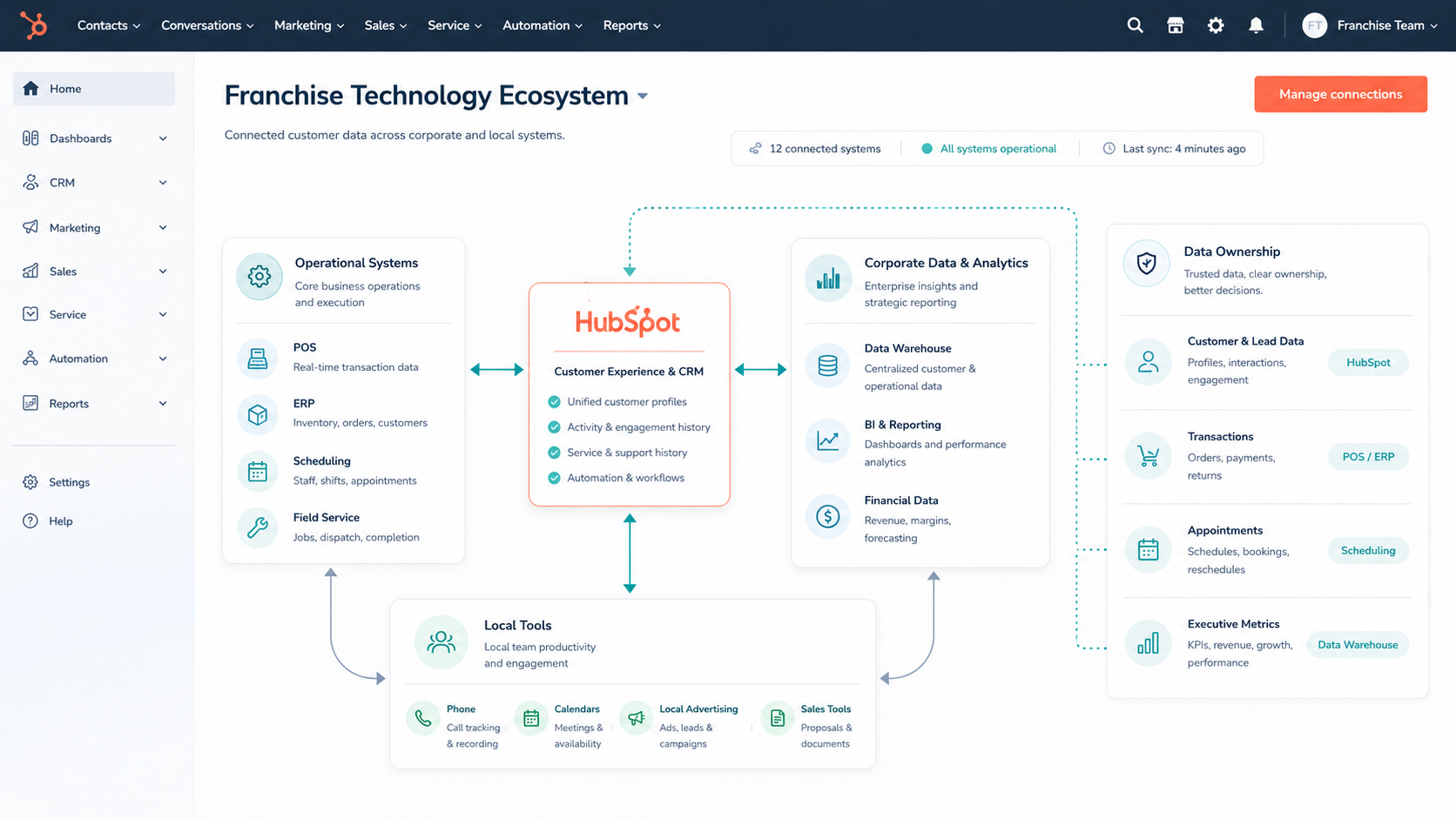
Connect the Franchise Technology Stack
For most franchise organizations, HubSpot shouldn't replace every system.
It should connect them.
Your website, CRM, POS, ERP, scheduling platform, call tracking system, franchise management software, customer service tools, data warehouse, and other applications all contain pieces of the customer journey.
We help determine which system should own which data—and how that information should move between systems.
A connected franchise ecosystem might include:
HubSpot
CRM, marketing automation, lead management, franchise development, customer communications, service, automation, and reporting.
Operational Systems
POS, ERP, scheduling, field service, membership, booking, ecommerce, or franchise-specific applications.
Corporate Data & Analytics
Data warehouses, BI platforms, financial reporting, and executive dashboards.
Local Tools
Phone systems, calendars, local advertising platforms, sales tools, and other location-level applications.
Instead of forcing every application into HubSpot, we build an architecture where HubSpot has the information necessary to coordinate the customer experience.
That means fewer disconnected databases, less manual reconciliation, and better visibility from corporate marketing all the way through local revenue.
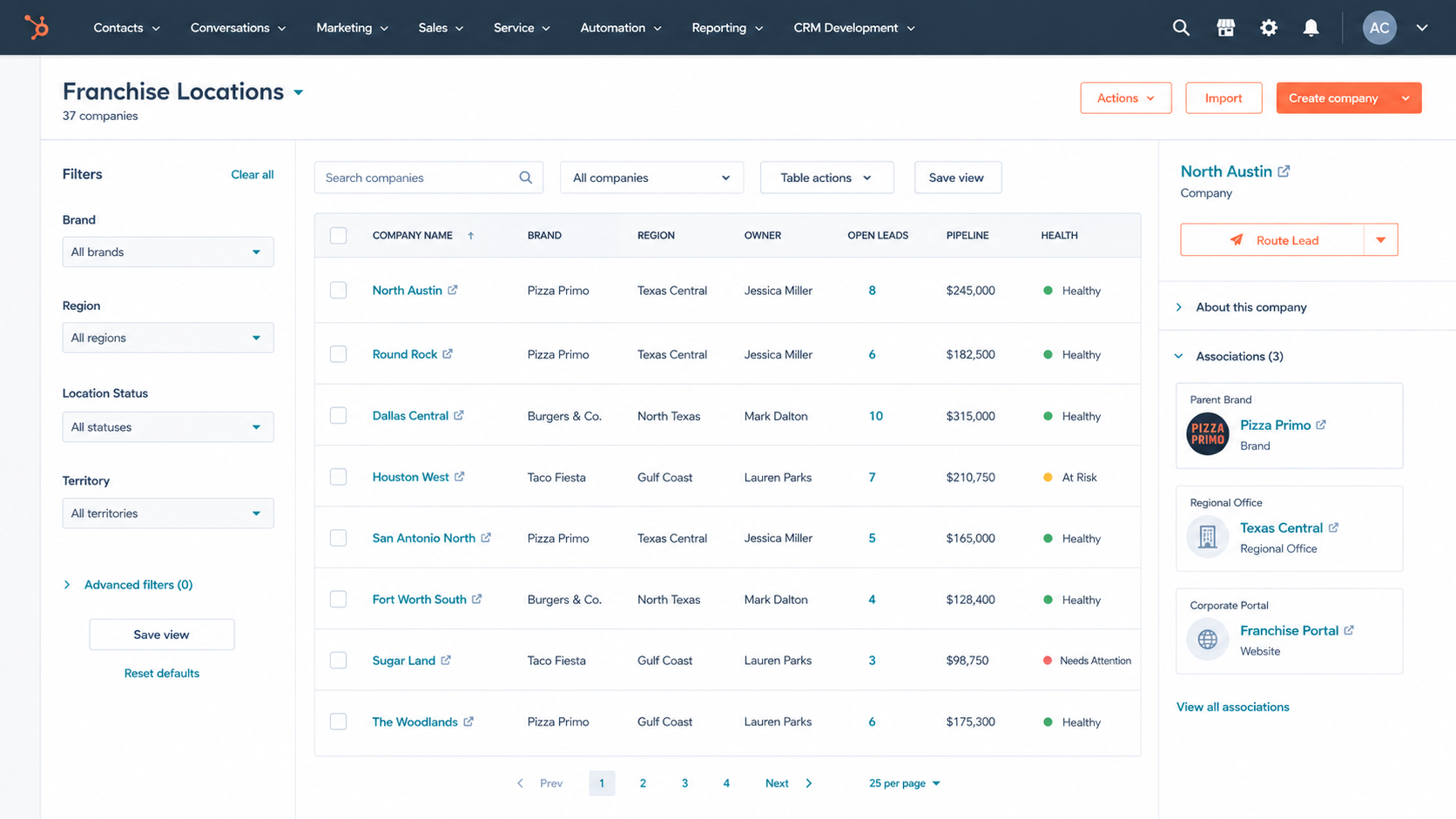
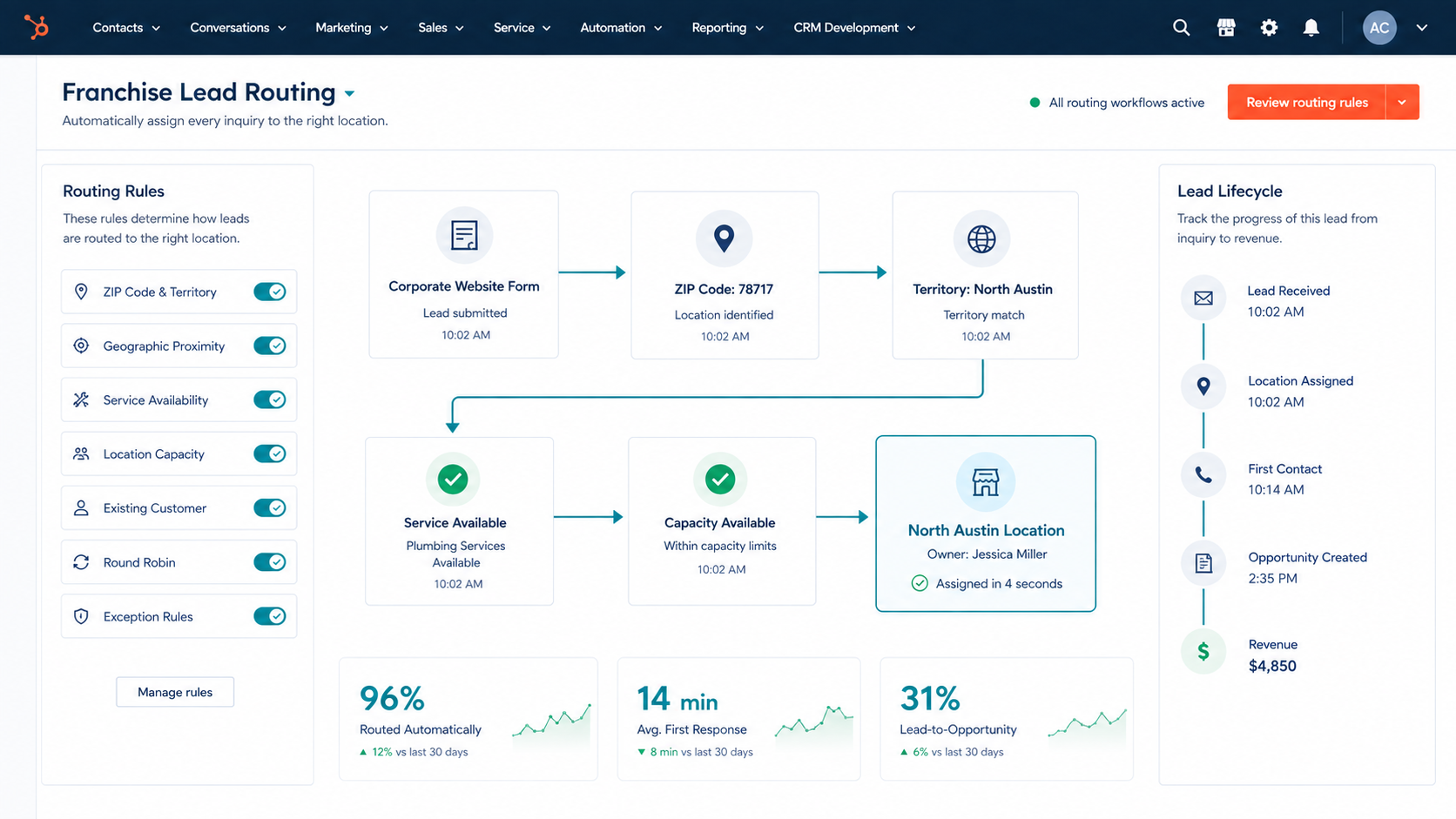
Route Every Lead to the Right Location
Lead distribution is one of the most important—and deceptively complicated—parts of franchise CRM architecture.
A customer fills out a form on the corporate website.
Who owns the lead?
The answer might depend on ZIP code, service territory, distance, product availability, franchise ownership, customer preference, capacity, operating hours, or dozens of other business rules.
We design automated lead-routing systems in HubSpot that can account for those rules.
Depending on your franchise model, routing can incorporate:
- ZIP codes
- Defined territories
- Geographic proximity
- Service areas
- Franchise ownership
- Product or service availability
- Lead type
- Customer type
- Existing customer relationships
- Location capacity
- Round-robin assignment
- Exception and reassignment rules
But routing the lead is only half the problem.
The bigger question is what happens afterward.
HubSpot can create a measurable lead lifecycle where corporate can understand when a lead was distributed, which location received it, whether the franchisee followed up, whether the lead became an opportunity, and ultimately whether it generated revenue.
That turns lead distribution from a routing exercise into a measurable revenue process.
Give Corporate Visibility Without Taking Away Local Control
Franchise organizations need standardization without making every location operate identically.
HubSpot can provide the common infrastructure.
Corporate teams can establish shared definitions for lifecycle stages, lead statuses, attribution, reporting, customer data, and core processes while allowing locations to retain appropriate control over their own pipelines and customer relationships.
The objective isn't to centralize everything.
It's to standardize the things that need to be standardized.
That can include:
- Common CRM data standards
- Required fields and validation
- Standard lifecycle definitions
- Shared pipeline architecture
- Corporate marketing campaigns
- Approved templates and content
- Lead response expectations
- Reporting standards
- Data governance
- Permission structures
Locations can then operate within that framework without corporate manually policing every process.
Turn Corporate Marketing Into Local Revenue
Corporate marketing teams face a difficult challenge.
You need to protect the brand while generating demand in hundreds of different local markets.
HubSpot can create a shared marketing infrastructure that supports both.
Corporate can develop campaigns, templates, workflows, landing pages, email programs, segmentation strategies, and reporting standards that can be deployed across the network.
Local teams can receive leads and execute within those systems without rebuilding the marketing engine themselves.
This makes it possible to create a repeatable model:
Corporate creates the engine.
Local markets activate it.
HubSpot measures the results.
For growing franchise systems, this can dramatically reduce duplicated effort while making sophisticated marketing capabilities available to locations that would never build them independently.
Connect Marketing Spend to Local Revenue
One of the hardest questions in franchising is also one of the most important:
Did our marketing actually generate revenue?
Corporate may generate the lead, a franchisee may close the customer, and the final transaction may occur in an entirely different system.
Without connected data, attribution stops somewhere in the middle.
We help franchises connect those pieces.
HubSpot can capture the original source and marketing journey, track the lead through distribution and follow-up, and receive downstream customer or transaction data from operational systems.
That creates the foundation for reporting that connects:
Marketing investment → Lead → Location → Opportunity → Customer → Revenue
Instead of optimizing around form submissions, corporate marketing can begin optimizing around actual business outcomes.
Build a Better Franchise Development Engine
Your customers aren't the only audience HubSpot can manage.
HubSpot can also support the process of growing the franchise network itself.
Franchise development teams can use HubSpot to manage the complete candidate journey—from initial inquiry through qualification, discovery, validation, and award.
A franchise development environment can include:
- Franchise candidate CRM
- Candidate lead scoring
- Automated follow-up
- Development pipelines
- Broker and referral tracking
- Territory interest
- Discovery Day management
- Candidate nurturing
- Document and milestone tracking
- Franchise sales reporting
- Source attribution
- Automated tasks and reminders
- Candidate communications
Marketing and franchise development can finally operate from the same underlying data.
That makes it possible to answer questions like which campaigns, portals, brokers, events, and referral sources generate the strongest franchise candidates—not simply the most inquiries.
Create a 360° View of Every Franchise Location
A franchise location isn't simply a company record.
It has owners, employees, territories, customers, marketing activity, performance metrics, agreements, support requests, training requirements, technology systems, and relationships with corporate.
HubSpot's flexible data model allows us to design CRM architecture around those relationships.
Depending on the franchise system, we may create dedicated records and associations for:
- Franchise locations
- Franchise owners
- Territories
- Brands
- Markets
- Customers
- Franchise candidates
- Agreements
- Equipment
- Projects
- Training
- Support cases
- Vendors
- Referral partners
This creates a more complete picture of the network and gives different corporate teams access to the information relevant to them.
Instead of treating HubSpot like a contact database, we design it around how your franchise actually operates.
One HubSpot Portal or Many?
This is one of the most consequential architecture decisions a franchise organization can make.
Should every franchise location operate inside one centralized HubSpot portal?
Should locations have separate portals?
Should groups of locations share portals?
Should corporate maintain a central environment while data synchronizes between independently managed franchise portals?
There isn't one correct answer.
The right architecture depends on factors such as franchise ownership, data privacy, brand structure, local autonomy, reporting requirements, marketing operations, technology maturity, and the number of locations.
Bayard Bradford specializes in multi-portal HubSpot environments.
We can help determine whether your organization needs:
A centralized architecture
One HubSpot environment supporting corporate and locations through teams, permissions, business units/brands, pipelines, segmentation, and structured data.
A decentralized architecture
Independent HubSpot portals for franchisees that need greater operational autonomy.
A connected multi-portal architecture
Corporate and franchise locations maintain separate HubSpot environments while selected data, processes, and assets are synchronized between them.
For large franchise networks, this architecture decision can determine whether HubSpot scales cleanly or becomes another fragmented system.
Already Have Multiple HubSpot Portals? Connect Them.
Many franchise organizations arrive at HubSpot organically.
Corporate buys HubSpot.
Then a franchisee buys HubSpot.
Then another does.
Eventually, the network has dozens—or potentially hundreds—of independent HubSpot portals with no shared data model or reporting structure.
Bayard Bradford and Datawarehouse.io specialize in solving this problem.
Our HubSpot portal synchronization and migration technology can help franchise organizations connect independent HubSpot environments without forcing every franchisee into a single portal.
Depending on the architecture, organizations can synchronize selected CRM data, maintain corporate visibility, distribute standardized structures, and consolidate portals when appropriate.
This creates another option between two extremes:
You don't necessarily have to choose between complete centralization and complete fragmentation.
Integrate HubSpot With the Systems Your Franchise Already Uses
Franchise technology ecosystems are rarely simple.
We've worked with organizations that need HubSpot connected to ERP platforms, POS systems, proprietary databases, field service applications, ecommerce platforms, quoting systems, data warehouses, and industry-specific software.
Our integration approach starts with the business process rather than the API.
We determine:
- Which system owns each type of data?
- Which information does HubSpot actually need?
- Which direction should the data flow?
- How quickly does it need to synchronize?
- What happens when records conflict?
- How should duplicates be handled?
- What happens when an integration fails?
- Who needs visibility into those failures?
From there, we determine the appropriate integration architecture.
That may include native HubSpot integrations, HubSpot Data Hub, iPaaS platforms, custom APIs, serverless integrations, scheduled synchronization, or a centralized data warehouse.
The objective is a maintainable architecture—not simply connecting two APIs because we can.
Give Franchisees a CRM They'll Actually Use
The best franchise CRM architecture is useless if franchisees don't use it.
That's why adoption has to be designed into the system.
Local users shouldn't have to understand your entire corporate data architecture just to follow up with a lead.
Their experience should be simple:
Here are my leads.
Here are the people I need to contact today.
Here are my opportunities.
Here is how I'm performing.
Everything else can happen behind the scenes.
We use automation, permissions, views, pipelines, playbooks, templates, sequences, dashboards, and AI to reduce the amount of administrative work required from individual locations.
Corporate gets better data because franchisees have fewer reasons not to enter it.
Use AI Across the Franchise Network
Once franchise data and processes are connected, AI becomes significantly more useful.
Instead of treating AI as a standalone chatbot, franchise organizations can apply it to real operational workflows.
Potential use cases include:
- Lead qualification
- Lead prioritization
- Automated research
- Sales call preparation
- Conversation summaries
- Follow-up recommendations
- Franchise candidate qualification
- Customer service assistance
- Knowledge retrieval
- Franchisee support
- Marketing content adaptation
- Data quality monitoring
- Pipeline risk identification
- Performance analysis
- Executive reporting
A franchise system with fragmented data will struggle to deploy AI effectively because the AI lacks reliable context.
Connecting the underlying data and processes creates the foundation for an AI-enabled franchise organization.
HubSpot Across the Franchise Lifecycle
HubSpot can support far more than lead generation.
Recruit Franchisees
Generate franchise inquiries, nurture candidates, manage the development pipeline, track referral sources, and measure franchise marketing ROI.
Onboard Franchisees
Coordinate onboarding milestones, communications, training, technology setup, and corporate handoffs.
Market Locally
Give franchisees access to scalable campaigns, templates, local landing pages, customer segmentation, and corporate-approved marketing resources.
Distribute Leads
Automatically route inquiries according to territories, geography, ownership, services, or custom business rules.
Manage Customers
Create a consistent CRM framework while giving franchisees visibility into their own customers and opportunities.
Support the Network
Manage franchisee questions, internal support requests, knowledge resources, and corporate communications.
Measure Performance
Connect marketing, CRM, operational, and revenue data to understand performance from the individual location to the entire network.
Grow the Network
Use the resulting data to identify opportunities, improve franchisee performance, optimize marketing investment, and support expansion.
HubSpot Solutions for Every Stage of Franchise Growth
The right HubSpot architecture depends heavily on the size and maturity of the network.
Emerging Franchises
Build the right foundation before complexity compounds. Establish CRM architecture, franchise development processes, lead routing, marketing automation, and reporting standards that can scale with the network.
Growing Franchise Systems
Standardize inconsistent processes, improve lead distribution, connect operational systems, establish corporate reporting, and give franchisees better tools.
Large Multi-Location Networks
Solve enterprise-scale challenges involving hundreds of locations, multiple HubSpot portals, complex integrations, data warehousing, governance, permissions, multi-brand architecture, and executive analytics.
Private Equity & Multi-Brand Platforms
Create common infrastructure across multiple portfolio brands while preserving the operational differences that make each business unique.
We've Done This
- Owner - Major Franchise Brand